
Which RSPS Type Fits Your Playstyle?
Not sure which RSPS type fits your playstyle? Compare economy, PvP, PvM, custom, and spawn servers to find the right server faster.
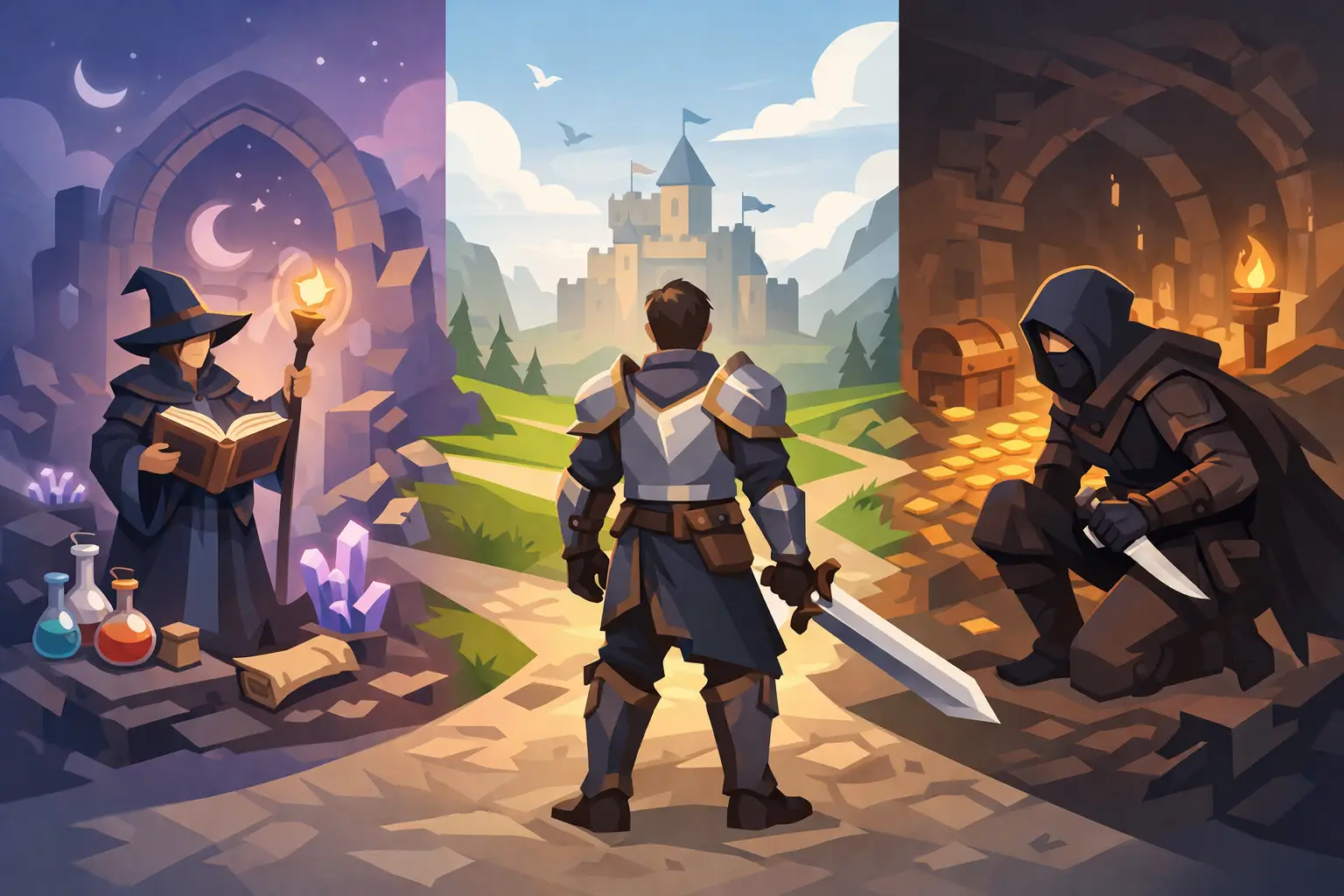
You can waste a full night hopping servers and still end up back where you started - in a login screen, wondering which RSPS type fits the way you actually want to play. That usually happens when players choose based on hype, not server structure. A server can have solid votes, active uptime, and still be the wrong fit for you.
The fastest way to choose well is to stop asking which server is best and start asking what kind of server loop keeps you engaged. In RSPS, type matters more than branding. Economy, spawn, PvP, PvM, custom, and revision-focused servers all create different expectations around progression, risk, grind, and community behavior.
Which RSPS type fits the way you play?
If your favorite part of RuneScape is building value over time, economy servers usually make the most sense. If you want instant gear access and nonstop fights, spawn servers are the cleaner fit. If bossing, drop tables, and account progression are what keep you logged in, PvM-focused worlds tend to hold attention longer.
That sounds simple, but most players overlap. You might like PvP, but only when gear loss feels fair. You might enjoy grinding, but not if the server turns early progression into a second job. The right choice depends on the ratio you want between effort and action.
Economy RSPS
Economy servers are built around progression that has weight. Items matter, skilling matters, drops matter, and trading matters. You earn gear instead of spawning it, which gives the server a stronger long-term loop if you enjoy building an account and participating in a live market.
This type fits players who want decisions to carry consequences. When supplies cost something and upgrades take time, boss kills feel more valuable and PvP risk feels more real. Community interaction also tends to be stronger because buying, selling, and price checking become part of everyday play.
The trade-off is pacing. A good economy server can feel rewarding for months, but a bad one feels slow within an hour. If rates are poorly tuned or the player base is too thin to support trading, the economy becomes friction instead of progression.
Spawn RSPS
Spawn servers remove most of that setup time. You get fast access to gear, quick builds, and immediate action. That makes them a strong fit for players who care less about account growth and more about testing setups, fighting often, or jumping into content without prep.
Spawn worlds are especially useful if your time is limited. You do not need to grind for two nights just to reach the part of the game you enjoy. For many PvP-first players, that is the whole point.
But spawn servers usually trade depth for speed. Because items are easier to access, the emotional value of progression drops. Retention depends more on how good the combat loop, balance, and event cycle are. If the PvP scene is uneven or the content rotation is weak, a spawn server can burn out fast.
PvP-focused RSPS
PvP servers sit close to spawn or economy models, but their identity is shaped by combat first. The question here is not just whether you like fighting. It is whether you like the specific kind of PvP the server supports - edge-style fights, deep wilderness risk, hybrids, NH, tournaments, or clan warfare.
A PvP server fits when competition is what keeps you engaged. You log in for matchups, loadouts, rankings, and momentum. You are less concerned with skilling depth and more concerned with whether combat feels responsive, fair, and active.
The catch is population quality. PvP content depends heavily on finding real opponents at the right skill spread. Even a technically polished server can feel flat if action is inconsistent or if a few dominant players choke out everyone else. For PvP, activity matters as much as features.
PvM-focused RSPS
If your best sessions are built around raids, bosses, upgrades, and account milestones, PvM servers are the safer bet. These servers are designed to reward planning, progression, and repeatable content loops rather than instant combat access.
PvM players usually care about encounter design and reward pacing. They want enough grind to make drops matter, but not so much that progression stalls. The strongest PvM servers keep that line tight. You always have a next target, a next unlock, or a next gear jump that feels achievable.
The risk is repetition. Some servers advertise massive PvM content, but most of it is just recycled combat with inflated health pools or noisy custom mechanics. If the progression path is wide but shallow, the server looks busy on paper and empty in practice.
Which RSPS type fits if you want something custom?
Custom RSPS can be the best or worst fit depending on why you play. If you are bored with standard content and want a server that remixes gear, systems, maps, or progression, custom worlds can feel fresh fast. They are often built to stand out, and that can be a real advantage when the design is coherent.
This type fits players who are open to learning a new logic. You are not expecting a near-clone of old-school gameplay. You want surprise, experimentation, and a break from the same route every other server follows.
The trade-off is consistency. The more custom a server gets, the more it depends on smart balancing and clear onboarding. If systems are stacked without structure, new players feel lost. Custom works best when the server still gives you a readable path forward.
Revision-based and legacy servers
Some players are not choosing by content loop first. They are choosing by era. If you specifically want 317, 474, 562, 718, pre-EoC, or another revision feel, that preference can matter more than whether the server is labeled PvM or economy.
Revision-based servers fit players chasing familiarity, combat feel, interface nostalgia, or a specific RuneScape period. This audience usually notices details quickly - animations, formulas, equipment handling, and how close the world feels to the version they remember.
The upside is clarity. If you know the era you want, your choices narrow fast. The downside is that nostalgia can hide weak design. A server may nail the revision look and still miss on stability, content cadence, or community activity.
How to decide faster without wasting time
The best filter is not marketing language. It is behavior. Before committing, look at what the server is asking you to do in your first hour and what it promises in your tenth. If the early game feels like friction and the long-term path feels vague, it is probably not your fit.
For players, three checks usually tell the truth. First, look at whether the server type matches your preferred loop - grind, fight, boss, trade, or experiment. Second, check signs of real activity such as current votes, visible uptime, and whether the server appears maintained. Third, look for a community pattern that matches your tolerance level. A high-intensity PvP world and a progression-heavy economy world create very different social environments.
For owners, the same logic applies from the other side. If you are listing a server, clarity around type is not optional. Players decide fast. If your server is really a PvM economy build with custom systems, say that clearly and let measurable signals such as votes and uptime support the pitch. Broad labels get clicks. Accurate labels get retention.
That is where a platform like Runix has real utility. Server discovery works better when players can compare categories, activity, and stability in one place instead of sorting through scattered claims. Better classification helps players choose faster and helps owners attract users who actually want their model.
A simple way to choose your fit
If you want long-term progression, choose economy or PvM. If you want instant action, choose spawn or PvP. If you want novelty, choose custom. If your priority is nostalgia, choose by revision first and server model second.
That will not answer every edge case, because some servers blend multiple types well. But it gets you close enough to avoid the biggest mistake in RSPS discovery - joining a server built for someone else and expecting it to become your kind of game.
The right server does not just look active. It matches the way you want to spend your next hundred hours.