
Why Do RSPS Die? The Failures That Empty Servers
Why do RSPS die? Learn what empties private servers, from weak launches and poor retention to broken economies, downtime, and lost player trust fast.
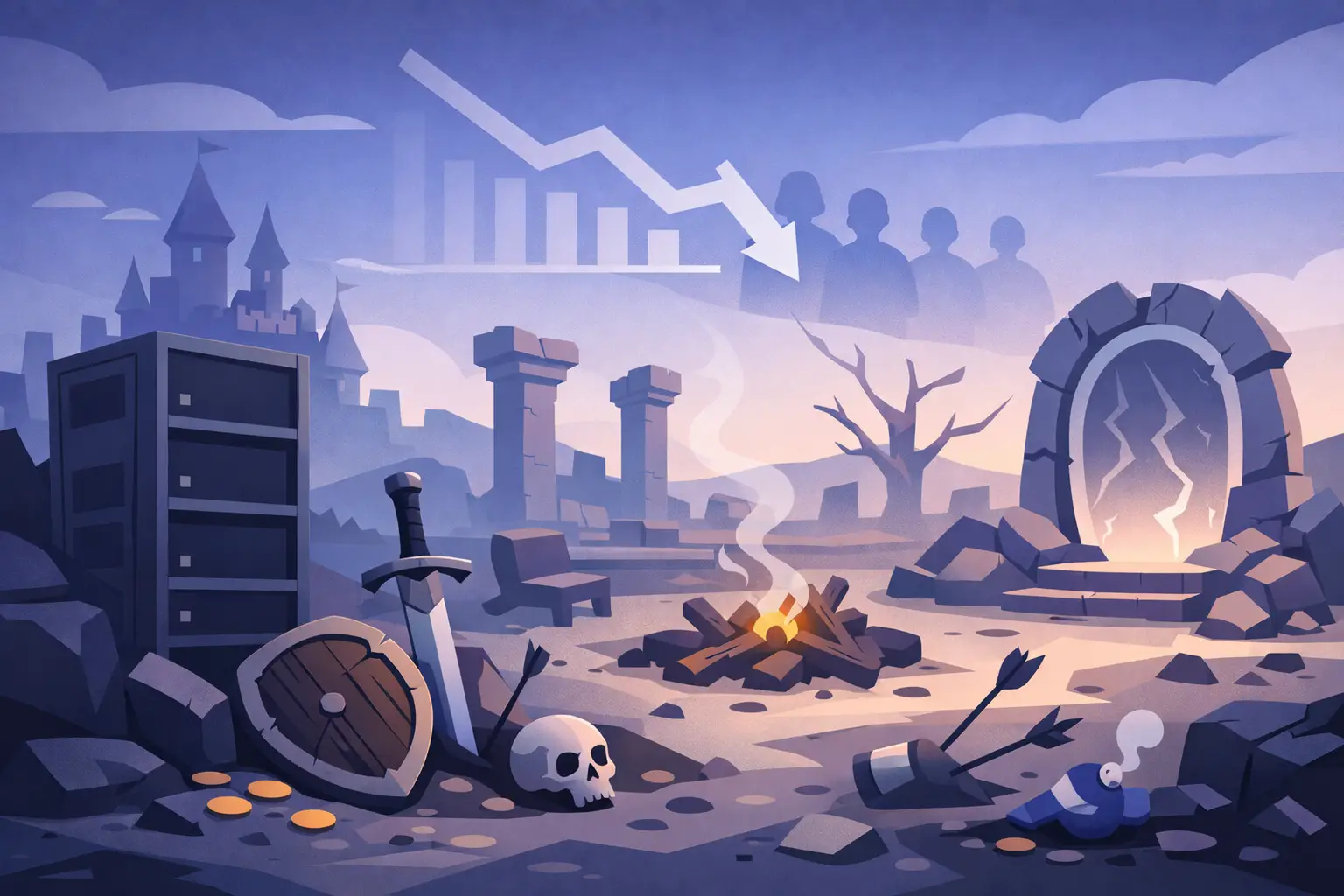
A server can launch with hundreds of Discord members, a polished trailer, and a strong first-day vote push, then feel abandoned two weeks later. That gap is the real answer to why do RSPS die: attention is easy to create compared with trust, retention, and repeatable operations.
For players, a dying RSPS means wasted download time, lost progress, and another Discord quietly going read-only. For owners, it means the hard truth that visibility alone cannot carry a server whose economy, updates, staff decisions, or technical performance push players away. Votes can put a server in front of the right audience. The experience decides whether that audience stays.
Why Do RSPS Die After a Strong Launch?
Most RSPS do not fail because nobody heard about them. They fail because the launch promise is larger than the live product.
A launch is a high-pressure moment. Owners promote early access, giveaways, content previews, and bonus rewards. Players arrive ready to test the combat, progression, economy, and community. If the server has unclear content direction, unfinished systems, or bugs in core loops, first impressions turn into exits fast.
The problem is often not a single major failure. It is a stack of small frustrations: a broken quest reward, a delayed staff response, unclear drop rates, lag during peak hours, or a shop that makes grinding feel pointless. Players may tolerate one issue. They rarely tolerate several when there are competing servers one search away.
A strong launch can also hide a weak foundation. Giveaway traffic, creator traffic, and launch-day incentives create a temporary population spike. If those players do not form clans, find goals worth chasing, or see a reason to return tomorrow, the online count falls as soon as the promotion slows.
Hype Is Not a Retention Strategy
Hype gets clicks. Retention comes from a clear answer to a simple player question: what should I do next?
The best servers give different player types a path. A PvMer can work toward a meaningful boss unlock. A PKer can find active brackets and fair incentives. An economy player can trade items with real demand. A casual player can make progress without feeling permanently behind. If every path ends in the same overpowered shop, repetitive boss, or inaccessible endgame, the server loses its middle.
That middle matters. New players need reachable milestones, while experienced players need long-term goals. A server built only for maxed accounts may attract veterans briefly but struggle to replace churn. A server built only around fast early progression may leave dedicated players with nothing to pursue after the first weekend.
The Failures That Drain an RSPS Community
A Broken or Inflated Economy
Economy problems are one of the fastest ways to damage player confidence. When rare items enter the game too quickly, prices collapse. When donation items overshadow earned gear, grinding loses value. When gold has no useful sinks, inflation turns ordinary rewards into clutter.
There is no perfect economy model for every RSPS. A fast-paced PK server can support aggressive item availability. A long-term PvM or economy server needs tighter control. What matters is consistency between the server’s stated identity and how value actually works in-game.
Owners should watch more than total wealth. Track the price and volume of key items, gold entering and leaving the game, time-to-gear for new accounts, and the gap between donors and non-donors. When a player believes the best route is swiping a card rather than playing, the server may still make short-term revenue. It usually loses long-term population.
Unfairness, or the Appearance of It
RSPS communities are competitive by nature. Players accept that owners need monetization, but they scrutinize every advantage. A donation perk that seems harmless to staff can look like pay-to-win to the player who just spent hours earning the same power level.
Favoritism is even more damaging. Staff spawning items, protecting friends, muting criticism, or applying rules selectively can empty a server faster than a content drought. The evidence does not have to be perfect. If players repeatedly believe outcomes are fixed behind the scenes, they leave and tell others why.
Transparency is a competitive advantage here. Publish rules, explain disciplinary decisions when appropriate, document major balance changes, and keep staff permissions controlled. Players do not expect perfection. They do expect a fair fight and a straight answer.
Updates That Are Too Slow, Too Random, or Too Risky
Players want updates, but more updates are not automatically better. A rushed update that breaks combat, wipes progress, or introduces an exploitable dupe can do more harm than waiting another week.
The common mistake is treating updates as announcements rather than operations. A server posts a roadmap, misses dates, pivots to a different feature, and leaves players guessing. After a few cycles, the roadmap stops building excitement because the community no longer believes it.
A better approach is smaller, tested releases with visible purpose. Explain what changed, why it changed, and what players should expect next. If a delay is necessary, communicate it early. Silence lets rumors fill the gap.
Downtime and Technical Instability
Uptime is not just a technical metric. It is a trust metric.
A player deciding where to invest 20 hours wants to know the server will still be available next week. Frequent crashes, rollback incidents, laggy combat, account issues, or an unreachable website signal operational risk. Even if the server returns quickly, repeated instability conditions players not to take progression seriously.
Owners should treat backups, monitoring, anti-DDoS planning, and incident communication as core product work. A stable server with fewer features can outperform a feature-heavy server that players cannot rely on. Public status and measurable uptime also help players compare options without relying on empty claims.
Staff Conflict and Community Drift
Many servers die in Discord before they die in-game. Arguments between owners, moderators, developers, and influential players become public. Rules change based on whoever is loudest. Feedback channels become complaint loops with no resolution.
A healthy community does not mean everyone agrees. It means there is a predictable way to disagree. Staff need defined responsibilities, escalation rules, and enough distance from personal disputes. Players need to see that feedback is heard, even when the answer is no.
Community drift happens when the server attracts an audience it was never designed to serve. An economy-focused project that chases every PK trend, or a nostalgia server that suddenly pivots into custom content, can lose its original base without gaining a durable new one. Growth should sharpen the server’s identity, not blur it.
What Owners Can Do Before Population Falls
The most useful metric is not peak players. It is whether people return after their first session, first week, and first month. A high peak followed by a steep drop is a warning that acquisition is working while retention is not.
Review the player journey with fresh eyes. Can a new player understand the game mode, find starter goals, join the economy, and get help without already knowing staff? Is the vote reward useful without being mandatory? Are progression and monetization clearly explained? If not, fix the friction before spending more on promotion.
Then match marketing to capacity. Do not buy a major boost or run a large campaign before the server is stable, staffed, and ready for feedback volume. More traffic magnifies both strengths and weaknesses. On Runix, real votes and uptime give players signals they can use quickly, but owners still need to earn every return visit after discovery.
It also pays to protect the core loop. Before adding another boss, minigame, or cosmetic system, ask whether existing players have reasons to log in, socialize, compete, and progress. New content can attract attention. A healthy loop creates a population that sustains itself.
What Players Should Check Before Investing Time
Players cannot eliminate risk, but they can avoid obvious warning signs. Look beyond a flashy player count. Check whether recent updates are specific, whether staff communication is active, whether uptime is consistent, and whether player feedback is answered with substance instead of defensiveness.
Spend your first session testing the basics. Try combat, banking, trading, teleporting, and the early progression path. Read the rules around donations and account security. If the server’s identity is unclear or the economy already feels compromised, it is usually better to move on before committing a weekend.
The RSPS scene will always have projects that rise quickly and disappear just as fast. The servers that last are not necessarily the loudest at launch. They are the ones that make players confident their time, progress, and feedback will still matter tomorrow.