
PVP Versus Skilling RSPS for Your Playstyle
Compare PVP versus skilling RSPS by progression, risk, economy, community, and uptime so you can find a server that matches how you play more often now.
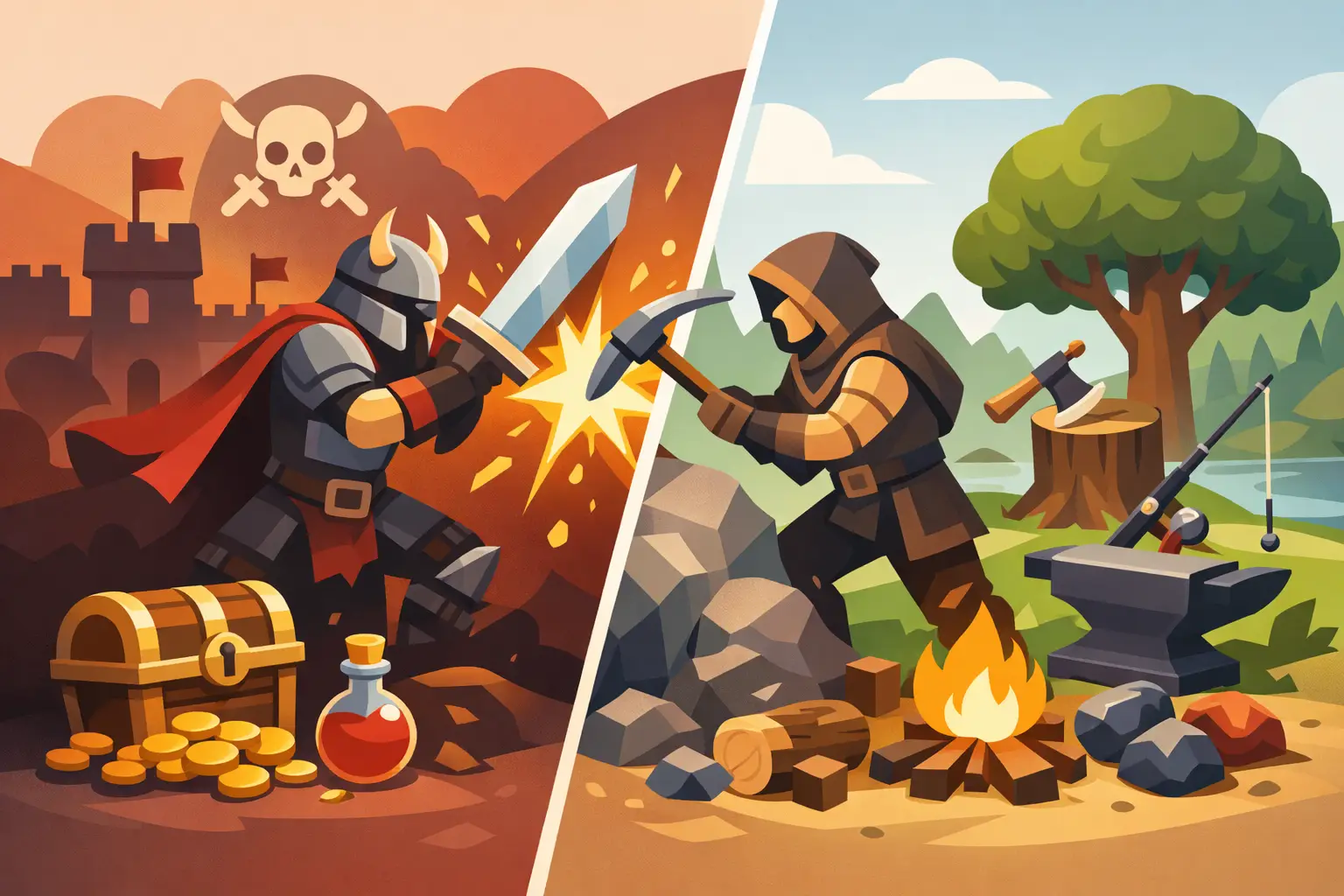
A server can have a polished home page, big XP rates, and hundreds of features, yet still be the wrong place to spend your time. The real choice in PVP versus skilling RSPS comes down to what makes a session feel worthwhile to you: beating another player under pressure, or building an account, bank, and reputation over time.
Neither format is automatically better. A strong PvP server can deliver instant action but feel repetitive if there is no reason to return after a kill streak. A strong skilling server can offer satisfying long-term progression but lose momentum when the economy is empty or updates move too slowly. The better pick is the server loop you will actually want to log into tomorrow.
PVP Versus Skilling RSPS: The Core Difference
PvP RSPS are built around competition. The fastest routes into combat matter most: accessible gear, active fight zones, clear rules, fair risk systems, and enough players online to keep encounters coming. Progression exists, but it is usually designed to support fighting rather than replace it. You may build a loadout, earn cosmetics, climb a killstreak ladder, or risk items for bigger rewards, but the payoff is player-versus-player action.
Skilling RSPS place the weight elsewhere. Players spend more time training skills, completing quests, bossing, collecting rare drops, trading, and improving an account. Combat can still be a major part of the experience, especially through PvM and raids, but it feeds a broader progression system. Your bank value, achievement unlocks, collection log, and long-term goals tend to matter as much as your combat record.
That difference changes how you should judge a listing. For a PvP world, peak player count and combat activity can decide everything. For a skilling world, you need to look harder at economy health, content depth, progression pacing, and whether the server has a stable population outside peak hours.
Choose PvP If You Want Immediate Stakes
PvP servers work best for players who want their decisions tested quickly. Gear selection, switches, prayers, timing, positioning, and matchup knowledge all show up in a single fight. The reward loop is direct: improve your mechanics, take better fights, and see the result immediately.
This is especially appealing if you do not want to spend weeks preparing an account before the main game begins. Many PvP-focused servers lower the barrier with starter kits, fast combat training, preset builds, or easy access to common gear. That is not necessarily “easy mode.” It shifts the skill test away from time invested and toward execution.
The trade-off is that activity matters more than almost any other metric. A well-built wilderness means very little if it is empty. Before committing, check whether recent player discussion centers on real fights, tournaments, clan competition, bounty systems, or active risk zones. Server uptime is also critical. Competitive players notice outages, rollbacks, and combat bugs fast because a lost fight or lost item can damage trust immediately.
PvP is also less forgiving of balance mistakes. Overpowered weapons, unclear safe-zone rules, excessive protection systems, or donation perks that create combat advantages can fracture a community. Some players enjoy chaotic custom combat. Others want an experience close to a familiar old-school ruleset. Read the server type and features carefully rather than assuming every PvP tag means the same thing.
What a Healthy PvP Server Looks Like
A healthy PvP community has visible reasons to fight beyond random encounters. Events, ladders, risk-reward areas, active clans, and recurring tournaments give players a reason to return. The best servers make loss meaningful without making a single death feel like account-ending punishment.
Look for transparency too. Clear item mechanics, known rules, responsive staff, and a track record of stable uptime matter more than exaggerated claims. A competitive server earns its reputation through repeatable, fair action.
Choose Skilling If You Want Progress That Sticks
Skilling RSPS are a better fit when you enjoy watching an account develop over dozens or hundreds of sessions. You might begin with a simple goal such as 99 Fishing, then find yourself chasing boss drops, building a maxed house, completing achievements, or collecting every rare item in a custom zone. The satisfaction comes from momentum.
The strongest skilling servers understand that faster XP alone is not content. High rates can be fun, particularly for players who do not want the original game’s grind, but fast leveling needs meaningful follow-through. Once skills are trained, there should be reasons to use them: crafting useful gear, supporting PvM, accessing profitable methods, contributing to the economy, or unlocking new areas.
Economy design is the pressure test. If common resources have no buyers, bosses print too much currency, or rare items are handed out too freely, progression loses value. On the other hand, an economy that is too restrictive can turn a private server into a second job. Good balance gives new players a viable starting path while preserving chase items and useful trade opportunities for established accounts.
Skilling communities also benefit from steady population rather than only a large peak. You want people trading, grouping for bosses, answering questions, and participating in updates throughout the day. A server with moderate but consistent activity can be a better home than one that spikes briefly after a launch and then fades.
What a Healthy Skilling Server Looks Like
Content variety is the first signal. Look beyond the skill list and ask what happens after early progression. Are there meaningful PvM tiers? Is there a reason to gather materials? Do achievements, quests, minigames, collection goals, or seasonal content create paths for different types of players?
The second signal is update discipline. A stable server does not need a giant patch every week, but it should communicate what is being improved and fix problems that affect progression or trading. Long-term players invest more than playtime. They invest confidence that their account and goals will still matter next month.
The Middle Ground: Hybrid Servers
Most RSPS do not sit at one extreme. A skilling server may have an active wilderness, while a PvP server may include bosses, raids, and account progression. That is why categories are a starting point, not a final verdict.
Hybrid servers are worth considering if you want flexibility. You can skill or boss when you are playing casually, then join events or risk fights when the population is active. The challenge is balance. If PvP rewards are dramatically better than every skilling method, peaceful progression can feel pointless. If items are endlessly protected and combat rewards are weak, the PvP side becomes decoration.
Ask one practical question: does each activity feed the others? A good hybrid economy lets skilling supply materials, PvM create valuable gear, and PvP remove or redistribute value through risk. When those loops connect, different player types can share one active world without one group being treated as an afterthought.
How to Compare Listings Before You Commit
Do not choose based only on a feature list. Every server can claim custom content, frequent updates, and an active community. Compare signals that are harder to inflate: current voting momentum, measurable uptime, clear server tags, recent player activity, and whether the stated game mode matches the discussion around it.
For PvP, prioritize active combat windows, rule clarity, event frequency, and the fairness of gear access. For skilling, prioritize the economy, progression depth, quality-of-life systems, and evidence that players remain engaged after the early grind. In both cases, check whether the server is stable and whether its staff communicates directly when issues arise.
A ranking directory is useful because it turns discovery into comparison. On Runix, real votes and uptime give players a faster way to separate visible momentum from empty promotion. Votes should not be your only decision point, but they are a useful indicator of which communities are currently earning attention.
Pick the Loop, Not the Label
If your best RuneScape memories involve freezing an opponent, protecting a streak, or winning a close risk fight, choose a PvP RSPS with proven activity and rules you trust. If you enjoy turning small gains into a powerful account, valuable bank, and completed goals, choose a skilling server with a healthy economy and enough content to outlast the first weekend.
The right server is not the one with the loudest launch announcement. It is the one whose next goal feels worth logging in for.